LEVEL 02 · IN DEVELOPMENT
Trashland Survivors
- Quest Design
- Level Design
- Economy & Balance
- Narrative
Hold your camp against the horde, one scavenging run at a time.
A mobile-first survivors-like with a base-defense twist. Auto-fire through swarms, scavenge scrap, and build up a camp that the bosses are coming to destroy.
- 1 month+
- BUILD TIME
- Solo
- TEAM
- 1-2 hrs
- FULL PLAYTHROUGH
- ROLE
- Game designer: quest design, level design, economy and balance, narrative
- ENGINE
- Unity 6 (URP)
- DURATION
- 1 month so far, solo
- PLATFORMS
- Portrait mobile, Telegram Mini App (WebGL)
DESIGN PILLARS
What the game is about
Camp is home
The horde hunts the camp, not the player, so the base always matters.
Risk buys reward
Scrap lies outside the walls. Leaving is a decision, not a chore.
Numbers you can see
Costs and levels are shown in the world, not buried in menus.
A story to finish
Quests and missions carry a simple story you can finish in 1 to 2 hours of straight play.
FEATURES
What's in the game
A tutorial that teaches by doing
The game opens with you waking up next to a walkie-talkie. You find a gun, walk to the camp and meet Eddy, who asks for scrap to fix the kitchen. When you bring it back, the camp management screen opens locked to the kitchen's repair button, so the first upgrade you make is also the lesson on how camp upgrades work. Then you patch yourself up, repair the watchtower and get ready to defend the camp.
Day/night cycle and weather
A day runs through dawn, morning, evening and night in about 10 minutes. The lighting fades from warm to cold blue and the HUD shows the current phase. Night is when the horde comes, so the clock sets the rhythm of the whole game. Weather switches between clear and rain, and the rain follows the player so it stays cheap enough for phones and browsers.
Auto-fire
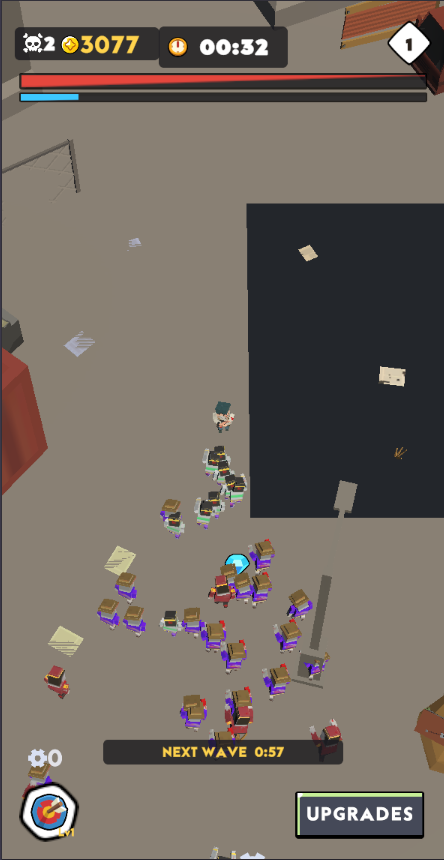
The weapon fires on its own at the nearest enemy, with multi-shot spread, so the player only moves. One thumb on a joystick decides positioning, when to fight and when to run, which is what makes it playable on a phone. Shots use ammo that you refill at the camp's ammo crate for coins.
Upgrade your gun
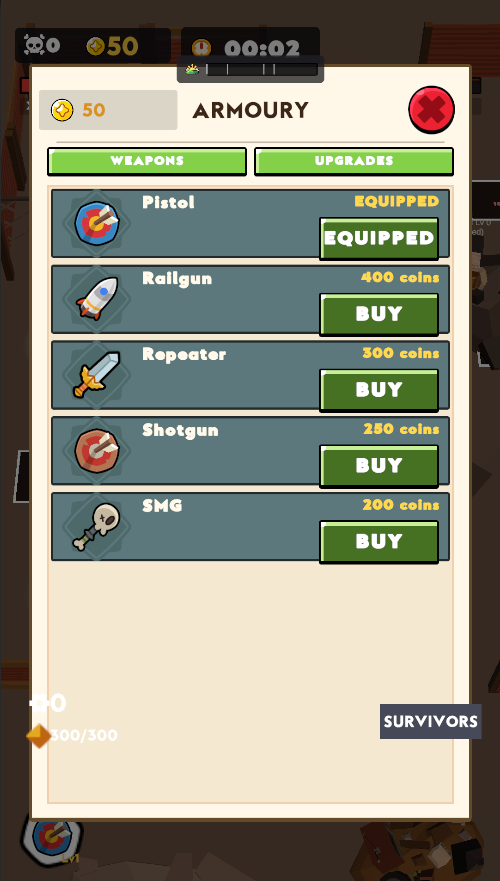
The Armoury in the camp is the only place to change weapons. Walk into it, wait a second for the ring to fill, and a screen opens. You can buy a weapon (pistol, SMG, repeater, shotgun, railgun), equip one, and upgrade its individual stats with coins. I removed the old random weapon pickups so the player's choices always come from spending, not luck.
A modular camp
Every camp building (kitchen, farm, workshop, watchtowers, the camp itself) is described by a data file with its own cost and effect per level, edited without touching code. The camp management screen builds its rows from that data. Adding another watchtower is copying one in the scene. This means new camp features can be added later as needs come up.
Quests as data, added on the air
Quests, objectives and dialogue are data, not code. A quest is a list of objectives with prerequisites, a type (collect, interact, talk, reach a place) and a reward, and the game only ever works with a plain quest model, whatever produced it. That is designed so a CMS API can add a new quest on the air with no rebuild. The game already loads live-tuning values, like when the first boss arrives, from the CMS this way.
A story of its own
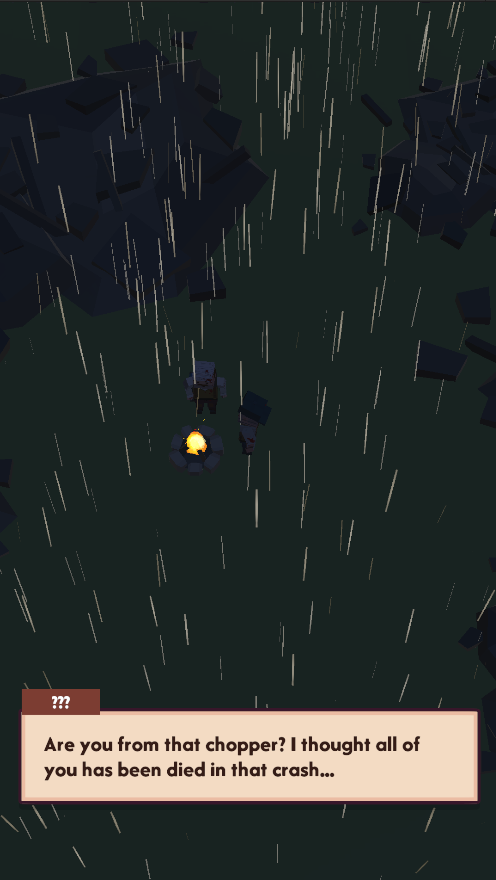
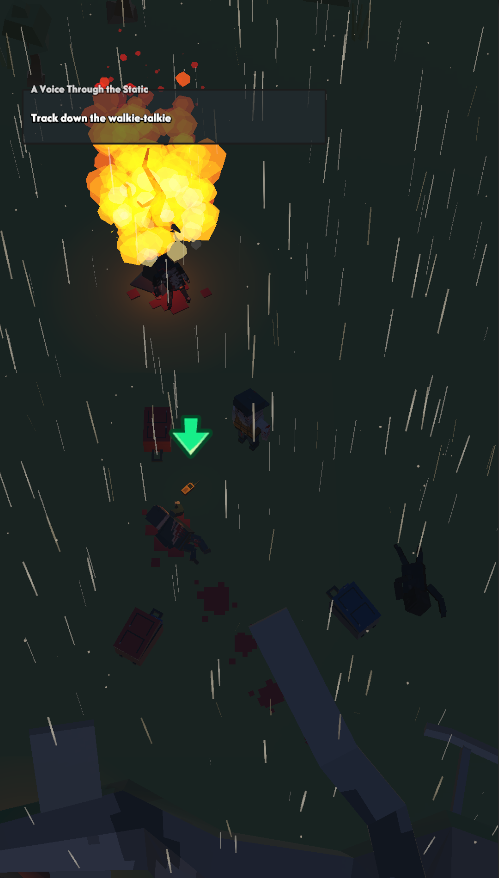
Trashland Survivors has its own story, told through quests and dialogue instead of cutscenes. After a helicopter crash you hear a voice through the static of a walkie-talkie and find a survivor named Eddy, who thought nobody from the chopper had lived. His camp is barely holding together: a dead kitchen, wrecked watchtowers and a horde on the way. Quests tie each step of the story to something you do in the world. The current objective always shows on screen with an arrow to the target, dialogue can pause or slow the world, and progress survives quitting, so you come back exactly where you left off. A full playthrough takes 1 to 2 hours.
LOOP
Core loop
- 1Take a quest
- 2Scavenge scrap
- 3Build and upgrade pads
- 4Wave hits the core
- 5Defend the core
- 6Finish the mission
- 7Arm up
- 8Beat the highscore
- REPEAT
My first game with quests and missions: they give each run a goal and move the story forward. The run ends if the player dies or the core falls.
THE PROBLEM
The challenge
Camp upgrades that never feel like a chore
Balancing the camp upgrades. Upgrading should never feel boring, so every upgrade has to unlock something new that makes the game easier, not just a bigger number. The work is deciding what each level opens up and when the player should get it.
Story quests without the slow edits
Story-driven quests were my first experience. Coming from development, I know what it means to have a system that isn't data-driven: every small change to the story costs a lot of time. That is why I focused on a modular camp system and a data-driven quest system, so changing the story or adding to the camp means editing data, not rebuilding the game.
Level design: a world worth exploring
Level design was the hardest part. I had to build a world full of elements that interact with the player and are always fun, sometimes scary in a funny-scary way. It needs plenty of room to explore, and enough reasons out there to tempt the player off the safe path.
Performance on low-end devices
The map is an open world with hundreds of props and game objects, and on cheaper phones the game started to struggle. My first idea was occlusion culling, which stops drawing things the player can't see. The game now turns off the rendering of props that are far from the player and turns them back on as the player gets near. Colliders stay on, so the gameplay never changes, and only the drawing is skipped.
OBJECTIVES
Design breakdown
- 1
A camp worth protecting
Waves and bosses march on a core with its own health bar. The run ends if the player dies or the core falls, so the player chooses when to intercept. Each wave brings 25% more enemies, so holding the camp gets harder the longer the story runs.
- 2
Two currencies, real trade-offs
Coins are the persistent meta currency. Scrap is per-run and scattered across the map. Building and upgrading camp structures costs both, checked together before either is spent. Build pads show their live cost in the world, so the economy is readable without a menu.
- 3
Fixing progression that could not progress
Playtesting showed the level-up bar never filled: the XP requirement scaled with account level and had grown out of reach, so level-up cards never appeared. I moved XP to a per-run curve so every run starts fast and the choose-one-of-three cards return, then lowered the early supply-cache XP reward so one pickup could not skip three levels.
ACHIEVEMENTS
What I learned
- Quest design: structuring objectives, prerequisites and dialogue so a tutorial teaches without lecturing.
- Level design for a base and a map: where camp pads, scrap fields and supply caches go so exploring is worth the risk.
- Balancing an economy and a character-level curve. A single exponential can silently break a whole system, and playtesting numbers matters more than trusting them.
- Storytelling through systems and dialogue: a tone for the camp and its survivors carried by quests, labels and barks.
MEDIA
Screens and video